
Interview with the President & CEO
Guided by the “3Rs,” Unicharm Aims to Become the Best Company in the World by 2030.
Prioritizing Absolute Value
Takahisa Takahara
President & CEO
— As the world changes at an unprecedented pace, companies are under increasing pressure to evolve. In an ever-changing operating environment, what kind of future does Unicharm seek to create? Please share your vision, President Takahisa Takahara.
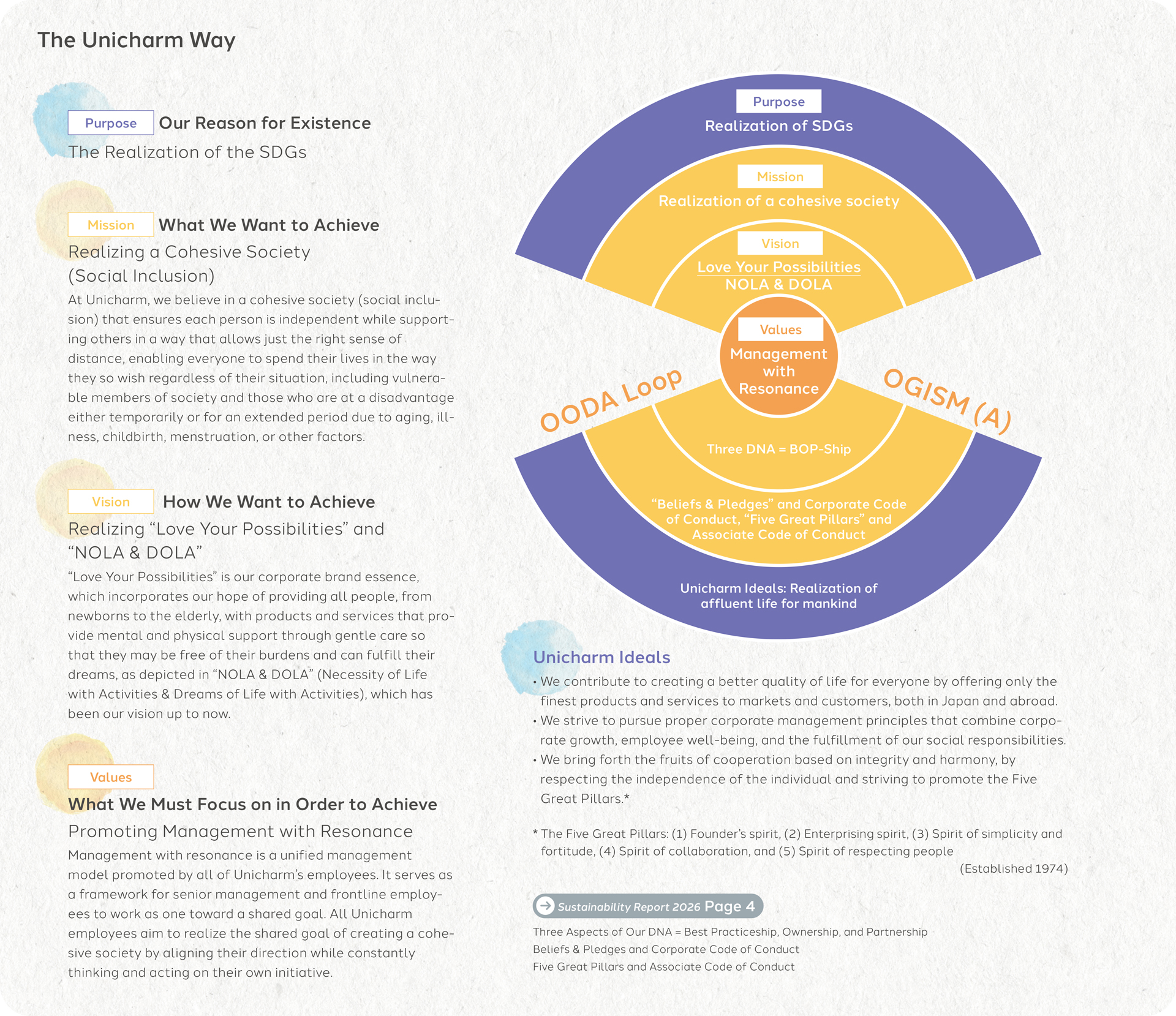
Takahisa Takahara (hereinafter Takahara): Our goal is to establish an unshakable position as the world’s leading value creation company. To achieve this goal, we have adopted aspirational targets for fiscal 2030 of net sales of ¥1,500 billion, a core operating income ratio and return on equity (ROE) of 17%, and market capitalization of ¥4,000 billion. However, these targets merely represent relative value for comparing ourselves with other companies. What matters most is that we keep creating absolute value that is unique to Unicharm. Specifically, we will embody Unicharm’s corporate brand essence, “Love Your Possibilities,” which we announced in 2024, to maximize the potential of all stakeholders—including consumers, society, and the global environment—thereby contributing to the realization of a cohesive society.
Unicharm’s Corporate Brand Essence:
“Love Your Possibilities”
This brand essence expresses Unicharm’s commitment to realizing a cohesive society in which all people are united and support one another, believing in their unlimited untapped potential and demonstrating this potential with a spirit of compassion and altruism.

Looking Back on the 12th Medium-Term Management Plan and Charting a Course for Future Growth
— In 2024, the year that Unicharm unveiled “Love Your Possibilities,” it also launched the 12th Medium-Term Management Plan, Project L.
How did the Company incorporate the aforementioned absolute value into specific strategies under this management plan?
Takahara: The basic strategy of Project L was to create absolute value that helps realize a cohesive society by developing products and services for women and to increase relative value by maximizing the lifetime value of all people and pets globally. In accordance with this basic strategy, we devised strategies for our four strategic business units (SBUs)—pet care, wellness care, feminine care, and baby and child care—and incorporated them into the strategies of local management units (LMUs) in the countries and regions in which we operate. Specifically, we developed a business model to maximize lifetime value in mature markets such as Japan, laid the groundwork for establishing pet care domain across multiple countries and regions, including China and Southeast Asia, and began building future growth engines in South America and Africa. We also conducted activities aimed at realizing a circular economy through the social implementation of Recycle for the Future (RefF), a scheme for recycling used disposable diapers.
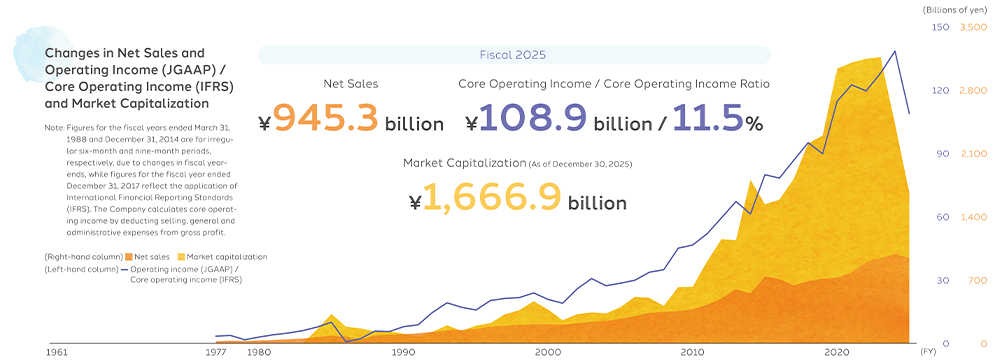
Thanks to these initiatives, in fiscal 2024 net sales reached ¥989.0 billion and core operating income came to ¥138.5 billion, a record-high performance. However, in fiscal 2025 we recorded net sales of ¥945.3 billion (down 4.4% year on year) and core operating income of ¥108.9 billion (down 21.4%), indicating issues to address in terms of growth potential and profitability.
— Despite record-high performance in fiscal 2024, sales and profits were down in fiscal 2025. What factors led to this decline?
Takahara: There were both internal and external factors at play. Internally, Unicharm’s unique mindset and behavioral traits, which emphasize high quality and stable supply and have been cultivated through experience in products like sanitary pads and disposable diapers, led to an overly cautious approach, resulting in delayed global expansion of wellness care and pet care. Externally, global inflation made consumers more budget-conscious, local competitors emerged in Asia, and there were rapid market structure changes in digital sales channels, including social media—such as TikTok—and e-commerce (EC), all of which further intensified competition.
Although said factors interacted in complex ways, I believe that the most important factor was the Company’s inability to break with its traditional mindset and behavioral traits.
In fiscal 2025, we sought to address these issues by stepping up investment in digital marketing and recording impairment of assets in Asia totaling approximately ¥6.0 billion, which put short-term pressure on our profits.
In light of these dramatic changes in the business environment, we decided to conclude the 12th Medium-Term Management Plan, Project L—which was initially due to cover the three years from fiscal 2024 to fiscal 2026—and transition to the 13th Medium-Term Management Plan, Project Renaissance, a freshly formulated five-year plan.
Launching the 13th Medium-Term Management Plan, Project Renaissance
— Could you elaborate on the specifics of Project Renaissance?
Takahara: This plan combines the latest AI technology with human sensibilities and the implementation of structural reforms to return Unicharm to a new growth trajectory and bring about the Company’s rebirth. The core of the plan is the “3Rs”: “Renaissance,” “Rebirth,” and “Resonance.”
The first of these, “Renaissance,” signifies a renewed focus on human sensibilities, which we had risked losing sight of in our eagerness to pursue efficiency and scale, and a return to human-centered value creation. “Rebirth,” meanwhile, aims to facilitate Unicharm’s reinvention by moving away from an emphasis on self-sufficiency and a fixed identity as a manufacturer toward a business model that allows us to address customer needs promptly and effectively. Lastly, “Resonance” refers to deploying sustainability as a growth engine to create value through resonance with society. By integrating the “3Rs,” Unicharm will create highly unique and inimitable absolute value and evolve into a lifetime partner whose products and services consumers cannot imagine living without.
“Renaissance”
— Could you discuss the “3Rs” in a little more detail? First, for “Renaissance,” what is Unicharm seeking to return to?
Takahara: Just as the Renaissance of the 14th to 16th centuries reflected a return from a God-centered to a human-centered outlook, Unicharm will return from a mass-production model focused on things (products) to value creation centered on people (individual consumers). This return also represents our determination to address human pain and suffering, the most profoundly analog reality of all, by fully leveraging digital technologies. Unicharm’s greatest strength is its ability to support people throughout their lives—from newborns to the elderly—and pets. We will therefore build infrastructure that enables us to explore life cycle insight by consolidating a wide range of data that was previously fragmented across different SBUs. Exploring such insight will allow us to accurately identify touchpoints between life stages and propose solutions that address latent discomforts, even before the individuals concerned are aware of them.
To do so in an agile manner, we will deploy SBUs that cut across functional organizations, such as the marketing and product development divisions, thereby accelerating decision-making and implementation. In addition, approximately 1,300 scrums (the smallest management units at Unicharm, such as sections or groups) across the world already implement the Observe–Orient–Decide–Act (OODA) Loop methodology, enabling our employees to respond quickly to changes in the business environment by formulating, implementing, and revising action plans on a weekly basis. To supplement these efforts, we will launch OODA Loop with AI, which will accelerate the cycle by using AI to continuously collect and analyze information and incorporate insight derived from subtle data that humans may overlook.
When implementing OODA Loop with AI, it is critical to keep in mind the shu‑ha‑ri process for learning established principles, adapting them, and ultimately creating an independent approach. Shu involves learning best practices and mastering tried-and-true methods on the job, through a rigorously frontline-driven approach. Building on the foundation established in the shu phase, we will proceed to ha, enabling us to go beyond past successes and conventional thinking through unbiased, AI-powered analysis of our unique life cycle data. Lastly, with the aim of embodying “Love Your Possibilities,” our corporate brand essence, we will advance to the ri phase to unlock new markets by creating absolute value that meets latent, as yet unrecognized needs. I believe that following the shu‑ha‑ri process will enable Unicharm to consistently create products and services with high added value.
“Rebirth”
— Under “Rebirth,” you have stated that Unicharm will move away from an emphasis on self-sufficiency. Could you please elaborate?
Takahara: As part of business portfolio reforms, Unicharm will actively commit management resources to pet care and wellness care to raise their share of net sales from 38% as of fiscal 2025 to 44% in fiscal 2030, thereby achieving strong growth, with a compound annual growth rate (CAGR) of approximately 13%.
Geographically, we will focus on the Global South—namely, India, the Middle East, Africa, and South America—which have strong growth potential. Moving away from an emphasis on self-sufficiency will be key to rapid growth in these countries and regions. We will therefore evolve beyond our traditional focus on doing everything ourselves and pivot toward working together strategically with outstanding original equipment manufacturing (OEM*1) and original design manufacturing (ODM*1) partners that have local production infrastructure. Boldly leveraging external resources and shifting to AI will enable Unicharm to reinvent itself as an organization capable of simultaneously increasing its share in emerging markets, where robust demand is projected, enhancing return on investment (ROI), and achieving ongoing profitability improvements.
*1 OEM: Unicharm conducts development and design in-house and outsources only manufacturing.
ODM: Unicharm outsources not only manufacturing but all aspects of production, including design and development.
“Resonance”
— While Unicharm will increase speed and efficiency by concentrating management resources on certain businesses and moving away from an emphasis on self-sufficiency, how will the Company co-create value with consumers and society through “Resonance,” the third “R”?
Takahara: We position sustainability initiatives as sources of innovation that resonate deeply and allow us to create strong connections with consumers and society. At the core of our sustainability program is the social implementation of RefF, our business for the horizontal recycling of used disposable diapers. This initiative collects used disposable diapers, sterilizes and bleaches them using Unicharm’s proprietary ozone treatment technology, and recycles them into pulp and super absorbent polymers that are as good as new, a world first.*2 We are already expanding initiatives that use recycled pulp as a raw material, and we offer several products under our major brands. For example, we have launched products including Lifree Side Leak Prevention Tape‑on RefF disposable adult diapers in 2022, MamyPoko Pants RefF disposable baby diapers and Deo‑Toilet Deodorizing / Disinfecting Sheets RefF for cat toilets in 2024, and Deo‑Sand: Paper Sand That Deodorizes with Fragrance RefF Pure Floral Fragrance for cat toilets in 2025, which uses recycled super absorbent polymers.
The social implementation of RefF’s circular business model transforms consumers from people who merely use daily products into partners who help create and operate a circular economy, so that using Unicharm’s products also means helping safeguard the future of the planet.
I believe that bonds forged through shared ideals will translate into powerful brand equity for Unicharm, protecting it from being easily drawn into price competition and other pressures.
The Company is also focusing on the Sofy Be period and physical condition tracking app, a platform that supports customers throughout their lives.
*2 For horizontal recycling technology that recycles used disposable diapers into disposable diapers using ozone treatment technology (based on Unicharm research, December 2020)
— Could you discuss the value offered by the Sofy Be app?
Takahara: Sofy Be is more than just a period tracking app. Focused on hormones, which have a significant impact on women psychologically and physically, the app aims to become a partner that supports women’s well-being through daily interactions and a generative AI-powered chat function. Through Sofy Be, we will broaden our relationships with customers from single points of contact when they purchase our products to ongoing, day-to-day connections. By using the data we accumulate through these connections to offer personalized products and services tailored to individual characteristics, we will establish a co-creation relationship with customers and build deep bonds of trust that cannot be easily replicated by competitors.
Kyo-sei Life Vision 2035
— The 13th Medium-Term Management Plan, Project Renaissance, aims to achieve a major transformation. Could you outline how the plan relates to Kyo-sei Life Vision 2035 (Medium- to Long-Term ESG Goals), which was revised based on the five years of progress achieved under Kyo-sei Life Vision 2030, unveiled in 2020, and highlight the key points of this relationship?
Takahara: We integrated Kyo-sei Life Vision 2030 (Medium- to Long-Term ESG Goals) and Environmental Targets 2030, both of which were formulated in 2020, and revised them to create Kyo-sei Life Vision 2035 in October 2025 in order to steadily advance the value co-creation with consumers and society set forth in Project Renaissance. These targets include three major revisions, based on input from stakeholders.
First, we reduced the number of key themes (material issues) from 20 to 16 and revised the indicators to make them more specific and measurable. For Safeguarding the Well-Being of Individuals, we have set a target based on the projected number of users of our products and services in 2035. Second, we consolidated our natural environment goals set out in Environmental Targets 2030 into Kyo-sei Life Vision 2035 (Medium- to Long-Term ESG Goals). In addition to initiatives addressing climate change and reducing plastic use, we will amalgamate the promotion of resource recycling and environmental impact reductions through the social implementation of the aforementioned RefF. Third, in 2026 we put in place a system that enables every employee to tackle these initiatives in earnest by aligning all performance evaluations with key initiatives from Kyo-sei Life Vision 2035 and linking individual goals to Companywide goals. With all employees implementing Kyo-sei Life Vision 2035, we aim to address environmental and social issues through our business activities and achieve ongoing improvements to our corporate value.
Balancing Growth and Capital Efficiency
— Could you provide an overview of Unicharm’s roadmap for achieving its fiscal 2030 financial targets?
Takahara: We have adopted the following financial targets for fiscal 2030 as aspirational targets: net sales of ¥1,500 billion and a core operating income ratio and ROE of 17%. Having rigorously assessed risks arising from the uncertain business environment, we have also established net sales of ¥1,300 billion as a fixed target while aiming for our aspirational net sales target by overcoming any headwinds through steady and flexible adjustments to our strategies.
We have also decided to fundamentally revise our capital policy to break out of the current situation, in which our price-to-book ratio (PBR) has stagnated at approximately 2.0 times. Specifically, over the five years of the 13th Medium-Term Management Plan, we will raise the total shareholder payout ratio indicator from its current level of 50% or more to 65% or more. We will also further increase the earnings power of our core business to generate operating cash flows of up to ¥1,000 billion over the five years of the plan. Of this amount, we will prioritize approximately ¥400 billion for growth investments, including capital expenditures and digital transformation (DX) initiatives, and approximately ¥150 billion as reserves for conducting M&As to underpin agile growth. With these investments in place, we will allocate surplus funds to shareholder returns in a disciplined manner, thereby maintaining appropriate control of net assets. In these ways, we have positioned the five years of Project Renaissance as a period for focusing on business growth and capital optimization by rigorously creating a virtuous cycle in which we increase our earnings power and reinvest the cash we generate for growth while providing disciplined shareholder returns and increasing our ROE.
— In closing, what message do you have for stakeholders?
Takahara: To embody Unicharm’s corporate brand essence, “Love Your Possibilities,” all employees will fully demonstrate their capabilities by believing in their own potential and implementing management with resonance to inspire each other. We are committed to ensuring a reevaluation of our PBR from the equity market, achieving a dramatic increase in shareholder value, and becoming the world’s best company by 2030.
Takahisa Takahara
President & CEO
Unicharm Corporation
June 2026